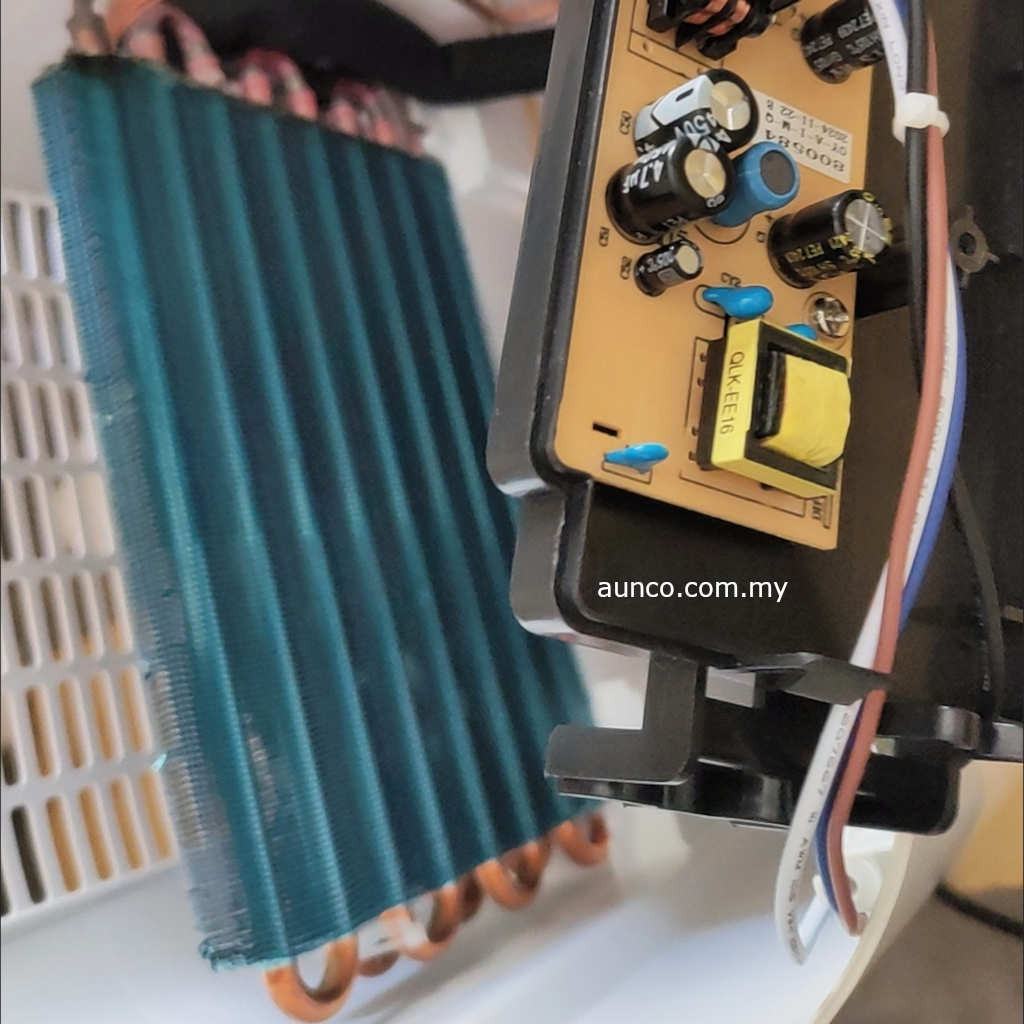
155W dehumidifier evaporator and PCB
Problem
When a storage room is kept open, humidity may not be an issue as there is air circulation. However dust will accumulate fast in the room. If the room is kept closed, dust will not accumulate fast, but trapped humidity becomes an issue.
Solution taken
A compressor dehumidifier was obtained. A machine is a cleaner option than quicklime (calcium oxide powder).
Notes
- The primary purpose of having a compressor dehumidifier is item preservation, such as mold and rust prevention. While it can improve comfort by reducing humidity, it also releases heat into the room, so comfort depends on the room temperature and humidity. If the ambient temperature is already high, the low humidity may provide some comfort if there is ample space in the room for the heat to dissipate. If the ambient temperature is about 20°C, then the comfort benefit becomes an added bonus.
- Four machines can remove moisture from the air: compressor refrigerant dehumidifier, rotary desiccant dehumidifier, Peltier thermoelectric dehumidifier and air-conditioner. Compressor dehumidifiers are generally much more energy-efficient than desiccant type and Peltier type. Its moisture removal rate gradually decreases as room temperature falls below 20°C. Its energy efficiency is viewed from the amount of water that it can remove from the air. It does not save electricity bill and we should expect some rise in the bill. However it indeed gives a cheaper bill compared to using an air-conditioner as a dehumidifier.
- The compressor dehumidifier will stop working when the built-in water bucket is full. For continuous operation, connect a discharge hose to the nearest drain hole.
- A compressor dehumidifier is heavier than a desiccant dehumidifier and Peltier dehumidifier, but it now has four wheels as its standard.
- The hot dry air from the dehumidifier can be directed at some items to speed up the drying such as clothes.
- As it is a high power appliance, do not use a trailing socket.
- Some points of consideration for getting a compressor dehumidifier:
- Power in watt, starting from 100W. The higher the power, the faster it can remove moisture, but also the more heat it generates. Using a high power machine in a small room will definite turn it to a hot room. A 155W dehumidifier generates about 155W of heat. For comparison, a resting adult releases about 100W (100 joules per second) of heat.
- Refrigerant type: R290 or R134a. R290 is more efficient. It is also more eco-friendly as it is just propane. Although propane is flammable, the humidifier is still safer than a cooking gas cylinder. If the manufacturer does not mention the refrigerant in the marketing material, then there is a high possibility that it uses R134a.
- The number of fins on the evaporator. The more fins there are, the larger the total surface area to capture the moisture.
- Dry air vent position: top outlet or side outlet. Theoretically top venting can give better air circulation in the room for better air drying.
- Access to the filter net. Snap-fit cover, magnetic cover or slide-out net. A snap-fit cover gives easy access to the net, but the snap-fit can wear out and loosen, causing vibration sound. A slide-out net does not need a removable cover, but when sliding out, some dust may drop.
- Overall machine width. With a larger width, the unit is more stable, the water bucket is not in an awkward deep C shape and the more spacious housing may improve internal airflow and ease of maintenance.
- Transparent or opaque water bucket for optional viewability.
- Optional lifting handle for the water bucket.
- WIFI connectivity for notification of full water bucket. This may be necessary only if the unit is to be put far away or there are a few units that need to be managed.
- UV designed to prevent mold and odor within the dehumidifier. If the UV is designed “to kill airborne germs”, then it is a marketing feature and should be avoided.
- Air filtration: Additional filtration may help remove airborne particles, but it can also increase airflow resistance. Dense filters, such as HEPA, reduce dehumidification performance immediately, while the benefit of keeping the evaporator clean is only realized over the long term. For most users, moisture removal should remain the primary consideration.
This is problem-first learning. The knowledge was learnt because there was a problem to solve.